 ROLAND-GARROS
17 May - 6 June 2027
ROLAND-GARROS
17 May - 6 June 2027


In 1996, Pete Sampras was carried by the memory of his recently deceased coach as he embarked on a heroic campaign at Roland-Garros, before losing in the semifinals to future champion Yevgeny Kafelnikov.
Back to the future – 1996: Sampras’ tear-jerking campaign
As we gear up for Roland-Garros 2026, let’s take a look back at the tournament’s anniversary editions.
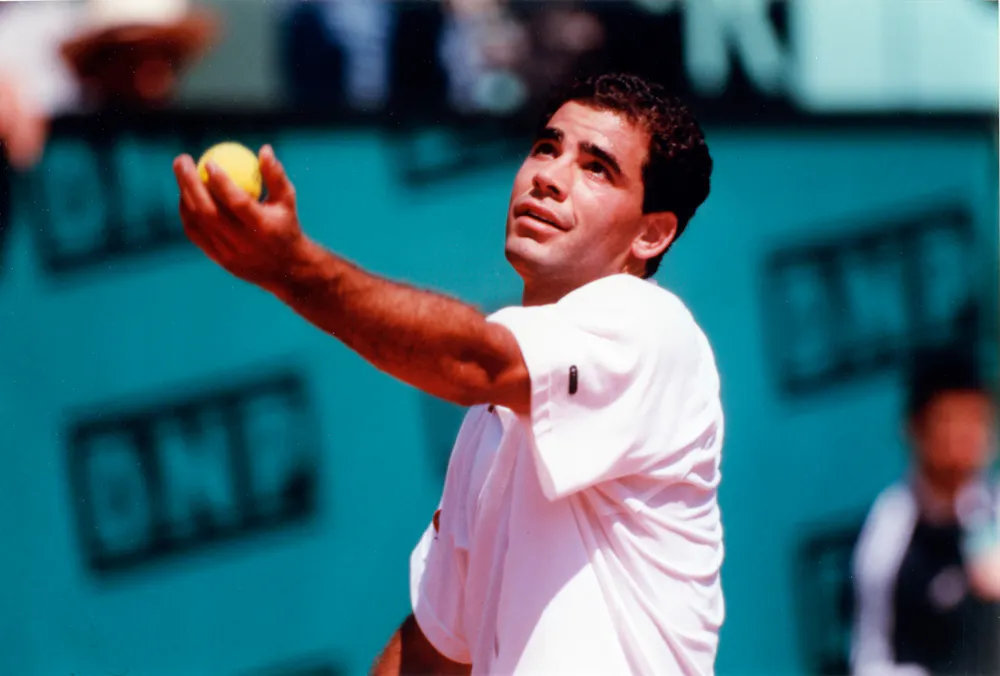
Sampras-Courier, a moment of silence
On the evening of Tuesday 4th June 1996, as centre court at Roland-Garros – which had not yet been given the name Philippe-Chatrier – was plunged into darkness, two men came, one after the other, to sit in the deserted president’s stand, as though coming to church to pray. Jim Courier and Pete Sampras had just finished playing a spectacular quarterfinal match, which was won by Sampras in 3 hours 31 minutes after being down two sets to love, 6-7 4-6, 6-4 6-4 6-4.
Sampras wanted to savour this win, the first – and only – time he progressed to the semifinals at the Porte d’Auteuil. But even though he did not let it show, he likely knew that he would not get any further that year. Completely exhausted and hindered by pain in his back and abs, he played his third five-setter of the fortnight, suffering a brutal semifinal defeat at the hands of Yevgeny Kafelnikov (7-6 6-0 6-2). The 22-year-old victor would go on to win both the singles and doubles at Roland-Garros, the first time anyone had achieved such a feat since Ken Rosewall in 1968.
Pete Sampras, on the other hand, would never win Roland-Garros and would never again progress to the second week of the tournament. He joined John McEnroe, Jimmy Connors, Boris Becker and Stefan Edberg – who, like Henri Leconte, made his final appearance in the tournament that year – on the list of “cursed” players in Paris. But, despite its painful ending, Sampras’ heroic run went down in the tournament’s history books.
An emotional tribute to Tim
Ironically, it was when expectations were lowest for the American that he came closest to lifting the trophy. On 3rd May, three weeks before the tournament began, he lost his coach, Tim Gullikson, who passed away at age 44 due to a brain tumour, an illness that Pete had unwittingly announced a year earlier, when he broke down in the middle of a match against Jim Courier, in the quarterfinals of the Australian Open.
Sampras' preparations were disrupted by this tragedy: as a result, he had only played two matches on clay (two losses), in the World Team Cup. The Roland-Garros draw, performed by footballers from PSG, was extremely unkind to him, pitting him against two-time Roland-Garros champions Sergi Bruguera in the second round and Jim Courier in the quarterfinals, as well as lining up a tricky duel in the third round against Todd Martin, who had finished runner-up at the US Open two years earlier.
Sampras managed to overcome these hurdles in five sets each time, experiencing a whole range of emotions and showcasing his aggressive playing style, undoubtedly helped by the exceptionally warm (and therefore fast) conditions, and seemingly carried by the memory of his former coach, whose twin brother (Tom) was by his side.
Against Bruguera, the World No.1 shot to a 2-0 lead by playing, in his own words, “the best serve-and-volley of my career on clay”. But in the end, on the same day that Andre Agassi was upset by Chris Woodruff, Sampras only managed to struggle through after three hours of play (6-3 6-4 6-7 2-6 6-3) and 57 winning serves. Then, against Todd Martin, he had to save two set points in the third set before finally winning the match 3-6 6-4 7-5 4-6 6-2.
But it was against his old rival Jim Courier that “Pistol Pete” played his most intense match, one that he won by fighting back from a two-set deficit and saving two break points at 4-3 in the fourth set, which would have left Courier serving for the match. One was with an ace right down the line on his second serve...after breaking a string on the first. A miracle!
As Sampras prepared to serve match point in the final set, Courier turned his back on the court and launched into a monologue of disbelief: “He always does this to me. The guy’s in his grave and he’s serving 190 mile-an-hour bullets.” And that is exactly what happened: a few seconds later, Sampras rounded off this legendary match with an ace.
Warmly congratulated on the players’ bench by his opponent, who had recovered his spirit of fair play and class, Sampras did everything he could to hold back the tears. But he finally crumbled upon leaving the court, when Nelson Montfort mentioned Tim Gullikson in his post-match interview. His tears were shared three days later by all the disappointed fans of Pete and his aggressive playing style.
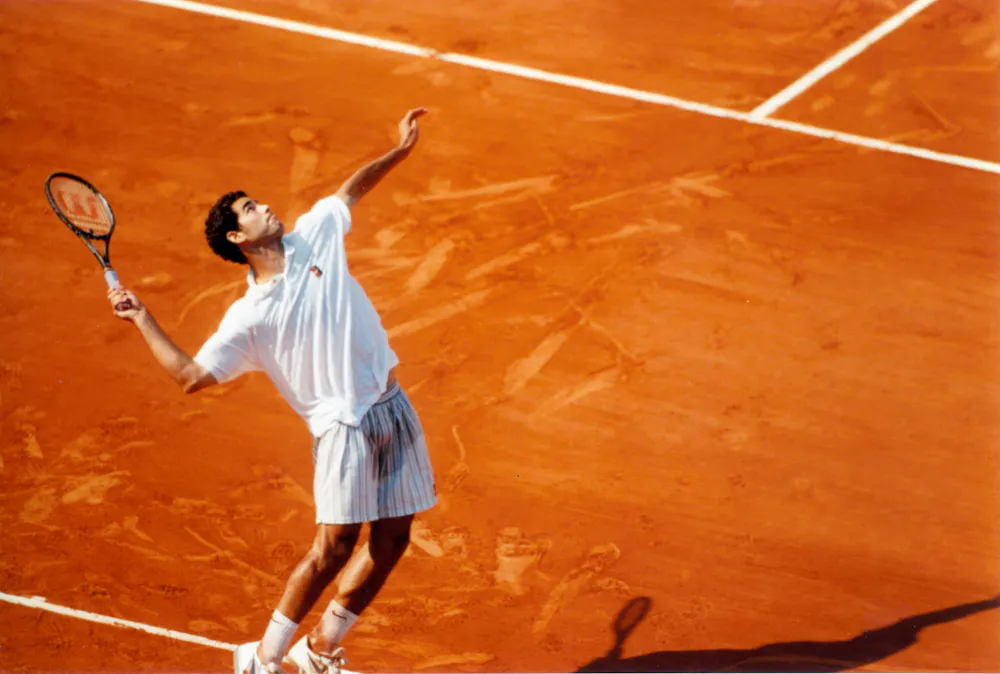
Graf-Sanchez, a legendary final
The 1996 edition will also be remembered for the extraordinary women’s final between Steffi Graf and Arantxa Sanchez, the third time they had met in the final at Roland-Garros. Like in 1989 (won by Sanchez) and 1995 (when Graf exacted her revenge), the match went to three sets. It was the German who came out on top after this magnificent and seemingly interminable final, during which Sanchez served twice for the match (at 5-4 and 7-6), before losing 6-3 6-7 10-8 in 3 hours 4 minutes.
Graf thus won the longest ever women’s final at Roland-Garros, both in terms of duration and number of games (40), breaking the previous record that had been set by…Graf-Sanchez in 1989 (2 hours 58 minutes). What is more, she became the woman with the most Grand Slam titles at the time (19) and broke the record for the highest number of matches won in Paris (73), ahead of Chris Evert. Truly historic, like we said.
Dates: 27th May – 9th June 1996
Women's final: S. Graf (GER) d. A. Sanchez (ESP): 6-3 6-7(4) 10-8
Men’s final: Y. Kafelnikov d. M. Stich (GER) 7-6(4) 7-5 7-6(4)