×

Day 13 Match of the day - part one

Alexander Zverev and Jakub Mensik battle for a place in Sunday's final

 - Alix Ramsay

Court Philippe-Chatrier, 14:30

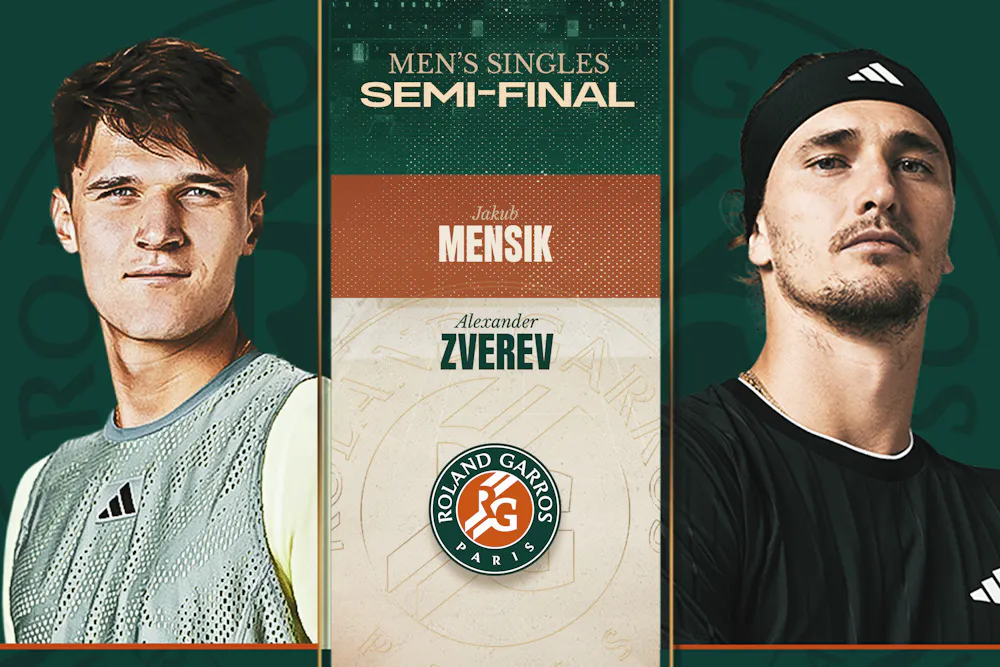
Jakub Mensik vs Alexander Zverev

To call Jakub Mensik’s run through the Roland-Garros draw “eventful” would be an understatement. He was down but not quite out in the second round; he was pushed to the limit again in the fourth round and then, in the quarterfinal, he played a match of such stupendous quality that not even he could quite believe it.

It is all part of the learning process for the level-headed 20-year-old from Czechia. On a fiercely hot afternoon in the first week, he spent nearly five hours battling to get the better of Mariano Navone in the second round. After winning the final point, he collapsed. He looked as if his tournament was over as he staggered off the court surrounded by medics. But he survived.

“If you would have told me at that moment that I would be in the semifinals, I would not have believed it,” he told the Tennis Channel. “At that time, I didn’t know where my limit is and that match showed me that, actually, my limit is more than I expected.”

Physically, then, he was learning. Then there was the mental side of playing best-of-five set matches. He was cruising at two sets up against Andrey Rublev a couple of rounds later. And then Rublev attacked.

“Best-of-five, it doesn’t matter if you are winning 2-0 or you are losing 2-0. It’s all about the momentum,” he went on. “He broke me in the third set and I felt that I was losing because I could feel the momentum from his side. Then it was basically the fifth set.”

That was another lesson learned. Then came Joao Fonseca in Tuesday night's quarterfinal. Again, he was in control of the first couple of sets and then the Brazilian went for broke. Six match points came and went as the two young men played lights-out and Fonseca forced the tiebreak. But once there, the calm, controlled Mensik got his way.

“I kept the momentum on my side,” he explained. “The last 20, 30 minutes of the match, it was just really insane the level from both of us.” 

Now, though, he must find a way past the vastly experienced 29-year-old Alexander Zverev. The German has been through all of this many times before and he is attempting to reach his fourth Grand Slam final and his second here. And he beat Mensik in three sets just a few weeks ago in Madrid.

Alexander Zverev, QF, Roland-Garros 2026

Alexander Zverev

“First of all, I will enjoy it,” the Czech said. “I have always dreamed of playing in the last matches of a Grand Slam, so I will enjoy it. I’m excited and I’m happy we played in Madrid so I could catch some rhythm and get to know him a little bit on the court.”

But Zverev on the regular tour is a different prospect to the Zverev who turns up at the major championships.

There is one item missing from the German’s impressive collection of 24 trophies and that is a Grand Slam. Three times he has come close but Dominic Thiem at the US Open, Jannik Sinner at the Australian Open and Carlos Alcaraz here all shattered his dreams.  

None of those men are here now and Zverev, the world No.3, is the out-and-out favourite for the title. He has been ever since Novak Djokovic went out in the first week. Does that weigh heavy on Zverev? No. Does he think about it? No. What does he think about, then? The next match. He is old enough and wise enough to realise that that is all he can do.

His search for that elusive Grand Slam title has looked, at times, painful. As the chances come and go, the scars must run deep. But when someone asked if he would trade his Olympic gold medal for one of those shiny cups, he was having none of it.

“No chance,” was the emphatic reply. “I will never trade my gold medal for anything.” But then he added, with a smile, “but I wouldn't mind to add a few things to my list as well.”

These courts are Zverev’s happiest hunting ground. He pushed Alcaraz hard over five sets in the 2024 final; this will be his fifth semifinal and he has three further quarterfinal finishes to his name. He plays his best on the Paris clay. He just needs to keep the blinkers on and focus on the first ball of the match ahead of him. That, though, can be easier said than done.

“For me it's quite simple,” he said. “It's me playing well. I think I really have to trust my game, and I have to trust my tennis and trust myself. If I play well, then I think that's 99 per cent of the work.”

It is that other one per cent that is always the most elusive.