 ROLAND-GARROS
17 May - 6 June 2027
ROLAND-GARROS
17 May - 6 June 2027


From 12 to 18 October, Asia’s top junior players will compete in the third edition of Roland-Garros Junior Series by Renault in Japan. Held at the Dai-Ichi Life Sogoen Tennis Court, the event offers a unique opportunity to earn a wild card into the junior draw of the 2027 edition of the Paris Grand Slam. Beyond the competition itself, the 32 participants (16 girls and 16 boys) will once again benefit from the guidance and expertise of Justine Henin, who remains deeply committed to the programme and to supporting the next generation of players.
Roland-Garros Junior Series by Renault 2026 – Justine Henin: ‘Relive this experience is an immense pleasure’
The four-time Paris Grand Slam champion takes her role as official ambassador of Roland-Garros Junior Series by Renault in Japan very seriously.
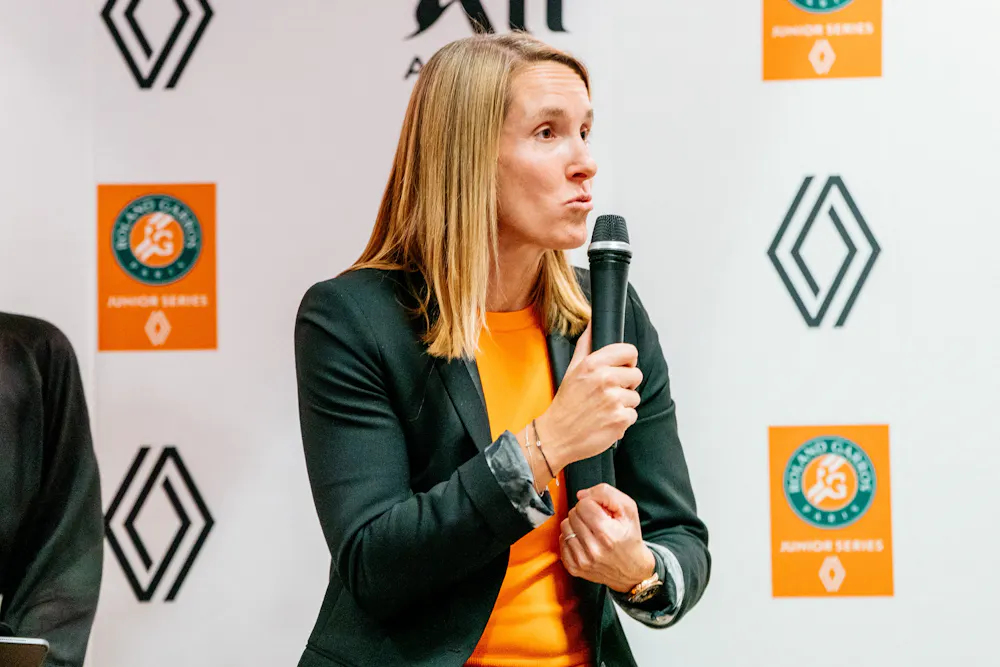
As official ambassador for a second consecutive year, how do you feel about returning to meet the young talents competing in Roland-Garros Junior Series by Renault 2026?
Justine Henin: Returning to Tokyo and relive this experience is an immense pleasure. Last year was a true discovery for me. I witnessed the event firsthand and saw its direct impact on these young players. Experiencing Roland-Garros in an entirely different part of the world and feeling the surrounding energy was incredible. Above all, there is a genuine commitment to offering these players an exceptional experience that prepares them for the next stages of their journey. I feel immense pride returning. I am also very curious, as no two journeys are ever the same. I look forward to meeting new players this year and discovering new paths.
What did you think of the level and willingness to learn displayed by the winners of the Brazil and Japan tournaments whom you coached in Paris before the junior events this year?
Seeing their nervous excitement – watching them take in the event for the first time – was moving. I initially observed them on the practice courts, then accompanied them across Roland-Garros and introduced them to the President of the French Tennis Federation, Gilles Moretton. It brought back memories of my own junior days and my very first visit to Roland-Garros, a place where you inevitably feel very small at first. These juniors earned their spots through a demanding, long-term qualification path that was already a major journey. Arriving in Paris was their moment of discovery. During that first training session, the pressure and desire to measure up were palpable. At the same time, there was immense joy in taking it all in.
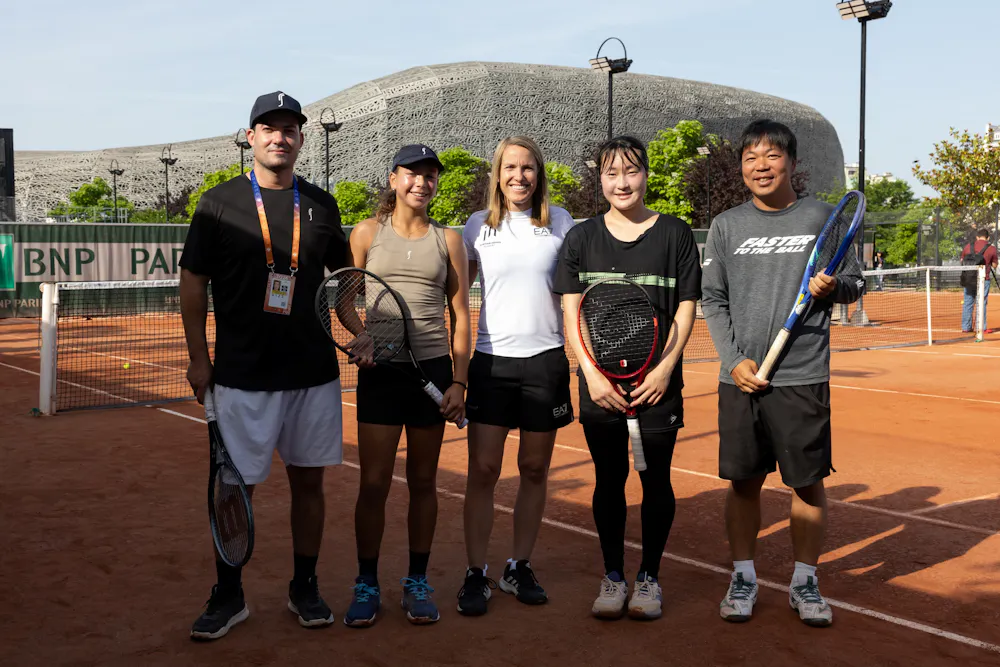
Sullevan Alves Bueno, Eduarda Gomes, Justine Henin & Yui Komada / Roland-Garros 2026
What message do you share about clay-court tennis, a surface that is both technically and tactically demanding?
The primary message on clay is patience. The physical demands are entirely different. The surface engages the body in a distinct way and requires targeted physical preparation. Players must sustain much longer rallies and recruit different muscle groups throughout the match.
In your opinion, what is the biggest challenge for a young player discovering clay and learning to adapt to it?
There is both a technical and a mental component.
Movement is a major hurdle. Not everyone naturally slides on clay, but mastering it is essential. Players must develop optimal movement mechanics to slide effectively and drive power up from the ground. Clay demands substantial leg drive to generate heavy, penetrating spin, it is a living surface. Even when players arrive without fully adjusting from hard courts, most quickly realize they must shape their trajectories and increase ball rotation. Clay also unlocks tactical creativity. Players theoretically have more time, allowing them to exploit court geometry and introduce varied pace and height. Because juniors spend most of the year on hard courts, the clay swing requires a mindset shift. Breaking out of flatter, more linear patterns to add variety takes time and deliberate work while staying true to one's baseline identity.
Mentally, players must accept having to hit one extra ball. Even behind a great serve, the ball will come back far more often than on a fast hard court. Success requires constructing the point patiently and accepting that extra shot. That discipline is often the hardest adjustment.
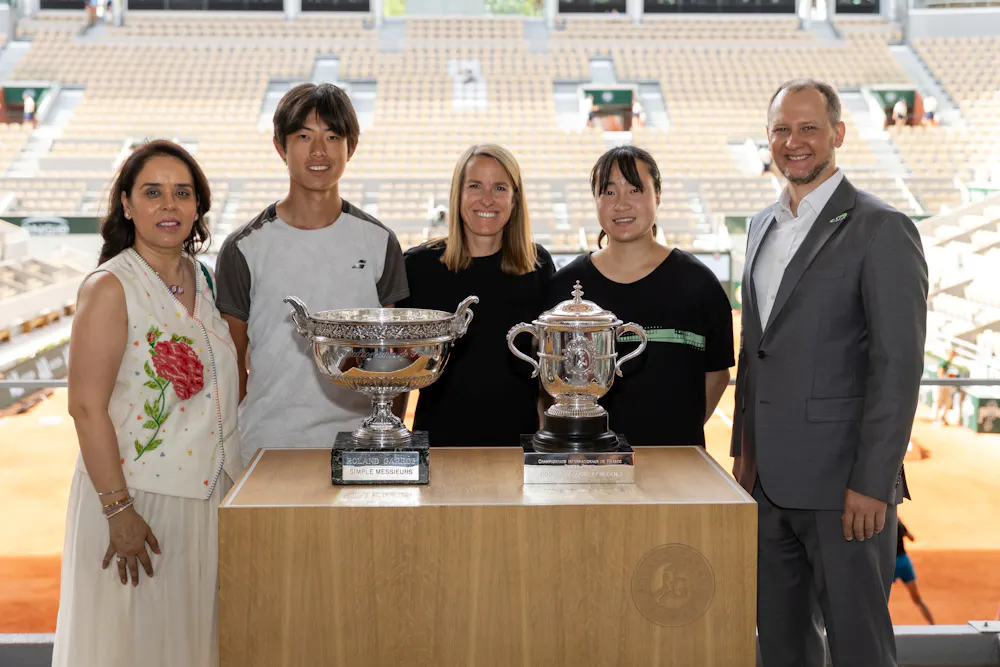
Manpreet Khandari, Kanta Watanabe, Justine Henin, Yui Komada & Yuriy Polski / Roland-Garros 2026
Beyond the advice you give on court, what do you hope to pass on to these young players as they prepare for professional tour?
Their career is a long path, not a sprint. It will involve obstacles, setbacks, defining encounters, and self-doubt. That is part of the process, and often the hardest reality to accept. Fortunately, when you start out, you do not know all the hurdles ahead. You need to approach that journey with curiosity and an open mind. A willingness to learn remains the ultimate differentiator. Great champions share a continuous appetite to learn from the people around them. No single person builds a player; it is the sum of meaningful encounters across a journey. They should try to make the absolute most of every experience, to live and breathe tennis from within. They must observe constantly that study other players, understand the sport's history, watch top professionals, and seek diverse sources of inspiration. Motivation must come from within, but it is fuelled by those who inspire you along the way.
How do you help players under 17 manage the stress and pressure of a major event like this?
We create dedicated touchpoints during the tournament for open discussion on whatever they wish to address. My stance is primarily observational: assessing their needs and remaining available when they want to talk. We don’t know each other yet and building that trust takes time. Some players initiate conversations naturally and others need space. Pressure management cannot be solved in a few minutes. It is long-term work. Each player must find mechanisms aligned with their personality. Their coaching teams have already established foundations, and the player’s job is identifying what keeps them grounded in high-stakes moments.
The priority is creating a personal bubble and filtering out external noise, and this is one of the toughest skills in elite sport. In an individual sport like tennis, outside expectations can become heavy, especially the fear of letting people down. It takes time to align your personal ambitions with your tennis project. There is no silver bullet. Every journey requires different tools. It is also important to remember that there will always be another important tournament after this one. No single event is an end. These players are still developing and keeping perspective amid the intensity of competition is vital.
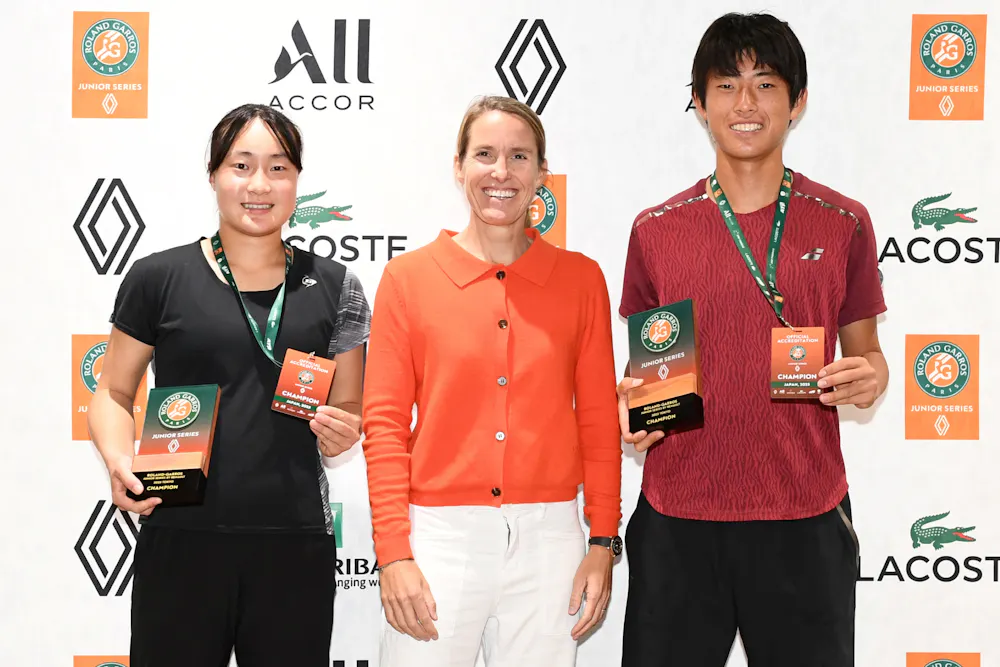
Yui Komada, Justine Henin & Kanta Watanabe / Roland-Garros Junior Series by Renault 2025
What memories do you have of the Japanese fans and tennis culture after your first year as official ambassador?
I have truly wonderful memories of the welcome I received last year. I received outstanding support from the local Federation team. Their energy, commitment to the project, and dedication to creating pathways for these juniors were remarkable.
The broader welcome across Japan was equally memorable. While I knew the culture from past visits, Japan also holds personal significance for me. At age 13, I competed in a world team championship in Yamanakako in August 1995, just months after losing my mother. It was an exceptionally tough period, far from home in an unfamiliar environment, but it became a defining moment of resilience in my life. Later, I returned for the Olympic Games.
Last year allowed me to experience Japanese culture and traditions more deeply. On a human level, it was incredibly enriching. From a tennis perspective, the work ethic of the coaches and players stood out. Technical rigor is paramount, resources are strong, and the culture of discipline and effort is deeply rooted. I also observed great humility and discretion. Earning their trust over the course of the week was deeply moving. The crowd brought wonderful enthusiasm, especially during the trophy presentation. The atmosphere had a unique energy that I look forward to experiencing again.
Roland-Garros Junior Series by Renault provides direct access to the Paris Grand Slam. What does such an opportunity mean for players of this age?
For the winners, it is an exceptional breakthrough. Grand Slams define tennis history. I still remember entering the Roland-Garros main draw in 1997 thinking: ‘I'm here. I’m inside the event.’ There is immense reverence for what the venue represents. I used to watch Roland-Garros on television, and I imagine many of these young players have done the same. To suddenly find yourself there in person is a very special experience.
While the transition from juniors to the pro circuit remains steep – and one must not mistake junior success for having "arrived" – the experience is irreplaceable fuel. To me, Roland-Garros is a magical place, although I admit I may not be entirely objective! These youngsters will compete in front of large crowds, on world-class courts, surrounded by the global tennis elite. Having lived it, I know what they will feel. They should absorb everything they can from the experience, especially since they will also cross paths with the greatest players in the world, many of whom are likely their idols. It delivers the exact inspiration an aspiring pro need.
During matches, what do you look for first when assessing whether a player has the potential to reach Grand Slam level?
Whenever I watch a match, I always begin by forming an overall impression. In fact, I also enjoy watching practice sessions and observing players away from competition. With some, body language and court presence immediately signal they belong. You see intent, self-belief, and conviction. Of course, doubt exists in everyone, but resilience and drive must override it.
That broader picture is what interests me most, more than any specific shot. Naturally, I also pay attention to how the ball comes off the racket, the quality of the strike and the physical dimension of the game. But above all, I focus on attitude, competitiveness and the way players respond to adversity. Those qualities often reveal a great deal about a player's character and their ability to rise to important occasions.
What lasting impact do you hope Roland-Garros Junior Series by Renault will have on the development of tennis in Asia?
We are laying building blocks, one stage at a time. This platform allows me to provide continuity, share my philosophy, and demonstrate what tennis teaches beyond results. The discipline required at elite level equips these juniors with life skills that extend far beyond the court. Being able to share that perspective is something I value greatly, and I am very grateful for the opportunity.
Long-term growth in the region depends on multiple stakeholders. Our role is maximizing visibility for Roland-Garros, sharing passion for the game, and inspiring young athletes to develop. My involvement is one piece of the puzzle, and many others have important roles to play. But the tournament serves as a catalyst for coaches, federations, and partners to collaborate on sustainable junior development across Asia.