×

AO 2026: Another slice of history for Carlos Alcaraz

Spaniard becomes youngest man to complete the career Grand Slam

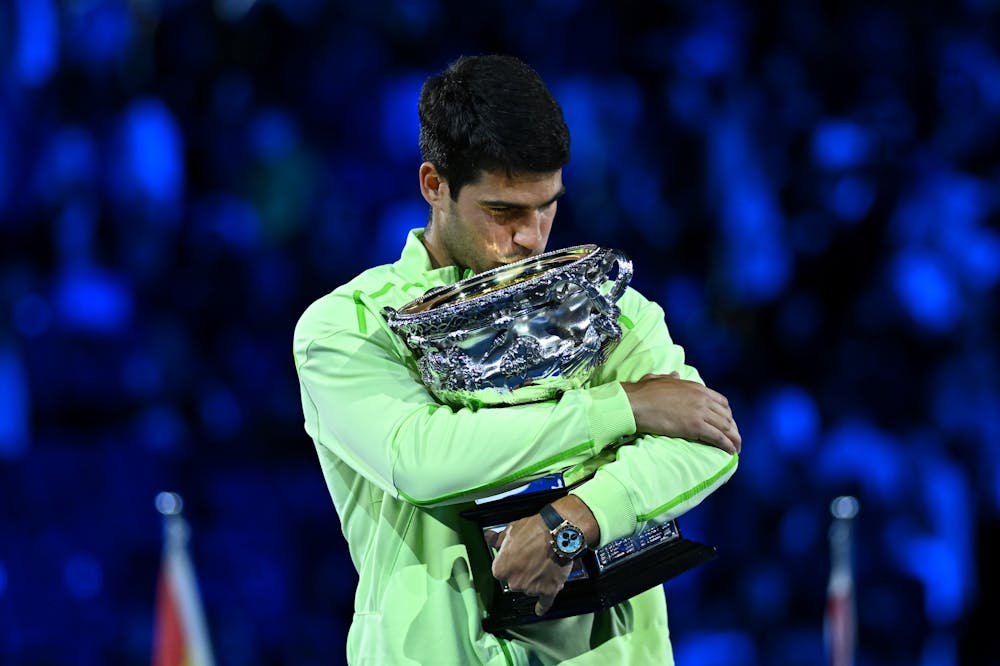
Carlos Alcaraz / Photocall trophée Open d'Australie 2026
 - Reem Abulleil

No matter what happened on Sunday in the Australian Open final, history was going to be made.

On one side of the net was a 38-year-old commonly described as the greatest-of-all-time. He was gunning for a record-extending 25th Grand Slam singles title, and his 11th crown at the Australian Open.

On the other side was a 22-year-old ranked No.1 in the world. He was gunning for a maiden Australian Open trophy that would make him the youngest man in tennis history to complete the career Grand Slam, breaking an 87-year-old record held by Don Budge since 1938.  

Separated by 16 years in age but mere inches when it comes to their games on court, Novak Djokovic and Carlos Alcaraz battled for a slice of history for three hours on Sunday before Alcaraz shook off his stubborn opponent 2-6, 6-2, 6-3, 7-5.

With another all-time great watching from the stands in the form of Rafael Nadal, Alcaraz handed Djokovic his first ever defeat in an Australian Open final and ended the Serb’s bid for what would have been the greatest triumph of his storied career.

Competing in a major final for the first time since Wimbledon 2024, Djokovic was looking to follow his incredible five-set victory over world No.2 Jannik Sinner in the semis with success over Alcaraz in the championship decider.

He ultimately fell just short but served a timely reminder that you should doubt champions at your own peril.

Alcaraz, whose seventh Grand Slam title means he has now completed his boxset of majors, was the first to heap praise on Djokovic after the final.

“What he's doing is inspiring. It is inspiring for all the athletes. It's not only tennis players but all the athletes, even myself,” said Alcaraz.

“What he's putting his body and his mind, his life into feel playing a final of a Grand Slam again, going against, you know, every people saying that he was not going to play another Grand Slam final or he was not going to beat Jannik or myself.

“Then he comes and playing such great tennis and beating Jannik in the semi-final, and here in the final played such great tennis. So it's unbelievable what he's doing.”

Alcaraz too is doing incredible things.

A commentator called him the world’s “greatest tennis mixologist” on Sunday and it was such an apt description of Alcaraz.

The range of variety in his skillset is why he’s been able to win each of the four majors at least once at the age of 22.

In the final, he hit 36 winners, including nine aces and six drop shots; he was 14/20 at the net, and broke serve five times.

Having never made it past the quarter-finals in four previous appearances at the Australian Open, Alcaraz was thrilled to finally solve his Melbourne Park puzzle.

He also did it in the aftermath of parting ways with his long-time coach Juan Carlos Ferrero – a shock decision that had people doubting his readiness for the new tennis season.

“I think nobody knows how hard I’ve been working to get this trophy,” Alcaraz said during the trophy ceremony while addressing his team, which is now spearheaded by Samuel Lopez.

“I just chased this moment so much. The preseason was a bit of a roller coaster emotionally. And we went through, let’s say, not hearing anything about what the people were saying before coming to Australia. We just did the right work, you were pushing me every day to do all the right things, so I’m just really grateful for everyone I have in my corner right now and this trophy is always yours.”

Strong start from Novak

Djokovic made the first move, breaking in game four en route to a 4-1 advantage and he struck again to scoop the opening set in 33 minutes, winning 93 per cent of his first-serve points along the way and limiting Alcaraz to a 13 per cent success rate on the Spaniard’s second serve.

He later described it as “one of the best sets I've played the last couple years”.

Alcaraz responded immediately and took the second set in similar fashion, breaking Djokovic twice.

As the Serb walked off court for a toilet break, Alcaraz quizzed officials about their decision to partially close the roof of Rod Laver Arena, arguing that the players have a right to know why choices like that were being made.

It didn’t matter much as the world No.1 proceeded to take the next two sets to make history at Melbourne Park.

“Every year that I came here to Australia I was thinking about getting the trophy,” said Alcaraz, who is just the second Spanish man to win the Australian Open singles crown.

“Couldn't happen. Couldn't go farther than quarter-finals. You know, coming this year, hungry for more, ambitious for getting the trophy, and being strong mentally enough, not hearing anything or any words from the people. And then just playing a good tennis in this tournament means a lot, means the world to me, and it is a dream come true for me.”

Disappointed but content

The Djokovic-Alcaraz head-to-head record now stands at 5-5.

The last nine consecutive majors have been won by either Alcaraz or Sinner, and while Djokovic was unable to halt their duopoly, he is proud of making his way back to a Grand Slam final, which was the 38th of his career.

“For me it's always a pleasure to face him, because he definitely is one of the best players I've ever faced in my career,” said Djokovic.

“So, you know, he makes you play your best tennis in order to beat him, so you know, it's what I've done for, like, set and a half, but then, yeah, things changed and he deserved to win.”

He added: “I remain disappointed with the way I felt in second and third after an incredible start, and I felt great about myself and then, yeah, things changed.

“It is what it is. That's sport, but of course, when you draw a line and you make, you know, assessment of what happened last couple of weeks, it's incredible achievement for me to be able to play finals, be couple of sets away maybe to win a championship.

“Of course, after a loss, it's a bitter feeling, but nevertheless, I have to be, yeah, content with this result.”

Djokovic hinted at a physical problem that hampered him in the second and third sets but refused to elaborate, worrying it would sound like an excuse and would take away credit from his opponent.

“Some things happened, and my energy, my level went completely down from north to south in two games,” said Djokovic, who had a visit from the doctor at some point during the match.

“I managed to recuperate and kind of feel re-energised midway through the fourth set. I was close. I was close, but it wasn't meant to be.”